We proudly support USARK because ethical husbandry and keeper advocacy go hand in hand. USARK protects the herpetoculture community and our cold-blooded family members through science-based legislation, education, and proactive defense of responsible animal care.
Silver Vase Plant (Aechmea fasciata)
Silver Vase Plant (Aechmea fasciata)
Regular price
$44.99 USD
Regular price
Sale price
$44.99 USD
Shipping calculated at checkout.
Quantity
Couldn't load pickup availability
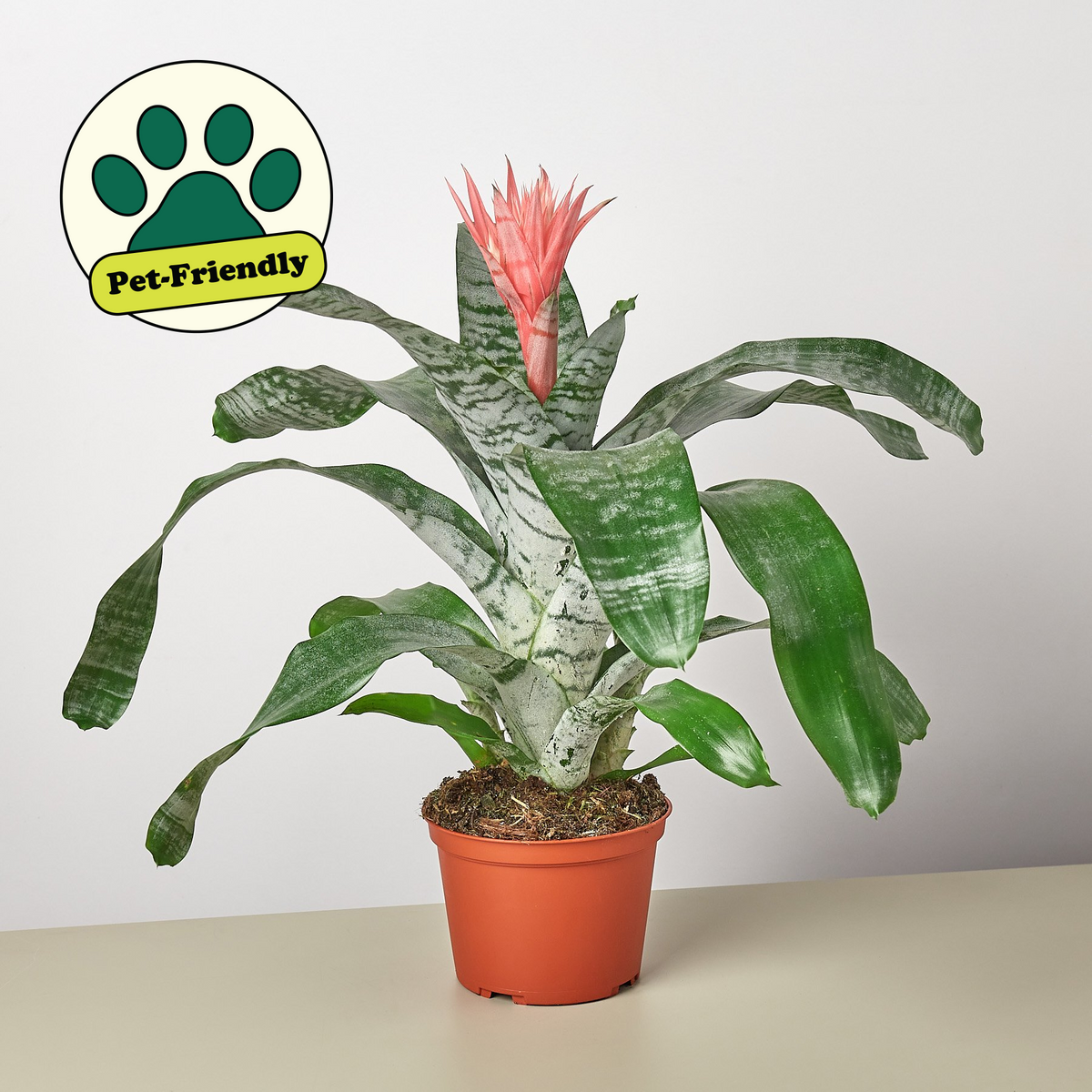
Bring dramatic canopy architecture, silvery foliage, and functional living water catchment to large vivariums with the Silver Vase Plant (Aechmea fasciata, often referred to as Bromeliad Fasciata or Urn Plant). Native to the tropical rainforests of southeastern Brazil, this robust epiphyte forms an expansive, wide-flaring rosette of thick, leathery, arching gray-green leaves coated in a powdery, silver-striped dusting (trichomes). Crowned by a long-lasting, bright pink inflorescence featuring miniature violet-blue blossoms, Aechmea fasciata is among the largest and most physically durable epiphytic bromeliads in herpetoculture, functioning simultaneously as an arboreal climbing highway and a multi-level hydration hub.
Bioactive & Husbandry Benefits
- Natural Living Water Reservoirs (Phytotelmata): The tight, overlapping leaf bases form a deep, water-tight central "urn" that naturally captures misting runoff, providing clean elevated drinking stations, soaking cavities, and tadpole-rearing sites for frogs and geckos that refuse ground dishes.
- Heavy-Duty Arboreal Load-Bearing: The stiff, fibrous leaves are exceptionally rigid compared to standard vivarium plants, effortlessly holding the perching and climbing weight of heavier arboreal species—including adult crested geckos, White's tree frogs, and juvenile semi-arboreal snakes—without drooping or snapping.
- Microclimate & Evaporative Humidity Buffer: Water held within the central cup continuously evaporates into the immediate canopy, creating localized elevated humidity zones that assist shedding and hydration without oversaturating the terrestrial substrate floor.
- Epiphytic Mounting Versatility: Possesses a tough, fibrous anchoring root system designed to grip bark rather than extract heavy soil nutrients. It mounts securely into large cork hollows, sturdy driftwood forks, or custom background ledges packed with sphagnum moss.
- 100% Non-Toxic Profile: Completely free from toxic alkaloids, caustic latex saps, and irritating calcium oxalate crystals. (Husbandry note: The outer margins of mature leaves feature tiny, serrated spines; scaled reptiles, large frogs, and invertebrates navigate them effortlessly, but keepers of hyper-delicate, soft-skinned micro-amphibians may prefer spineless bromeliad alternatives).
Habitat Specifications
- Light Requirements: Moderate to bright indirect vivarium LED lighting. (Bright illumination preserves the intense silver-banded powdering and supports pink bract longevity; keep leaf tips clear of high-heat, unshaded basking lamps).
- Humidity Range: 60% – 90%+ (thrives in humid tropical, sub-tropical, and cloud forest vivarium setups with adequate ventilation).
- Substrate & Moisture: Coarse, free-draining epiphytic blend (sphagnum moss, orchid bark, tree fern fiber, or chunky ABG mix) or mounted bare to hardscape with moss. Hydrate primarily by filling the central tank with fresh, dechlorinated water during mistings; allow root mounts to remain airy and free of waterlogged stagnation.
- Enclosure Placement: Midground to upper canopy in spacious, tall enclosures (minimum 24–36 inches in height); requires sturdy hardscape anchoring due to its mature size and water weight.
- Ideal Inhabitants: Crested geckos, gargoyle geckos, giant day geckos (Phelsuma grandis), White's tree frogs, Amazon milk frogs, dart frogs, juvenile green tree pythons or emerald tree boas, jumping spiders, and arboreal tarantulas.
- Structural Durability: Exceptionally High; one of the toughest, most crush-resistant canopy bromeliads available for medium-to-large terrarium inhabitants.
Bioactive Prep Tip: Thoroughly bare-root the plant to rinse away all commercial nursery substrate and fertilizer granules, gently flush the deep center urn and leaf axils repeatedly with clean dechlorinated water to remove debris, and securely anchor the base with zip-ties or floral wire to heavy hardscape until its anchoring roots take hold.