We proudly support USARK because ethical husbandry and keeper advocacy go hand in hand. USARK protects the herpetoculture community and our cold-blooded family members through science-based legislation, education, and proactive defense of responsible animal care.
Gasteria 'Durban' (Gasteria spp.)
Gasteria 'Durban' (Gasteria spp.)
Regular price
$26.99 USD
Regular price
Sale price
$26.99 USD
Shipping calculated at checkout.
Quantity
Couldn't load pickup availability
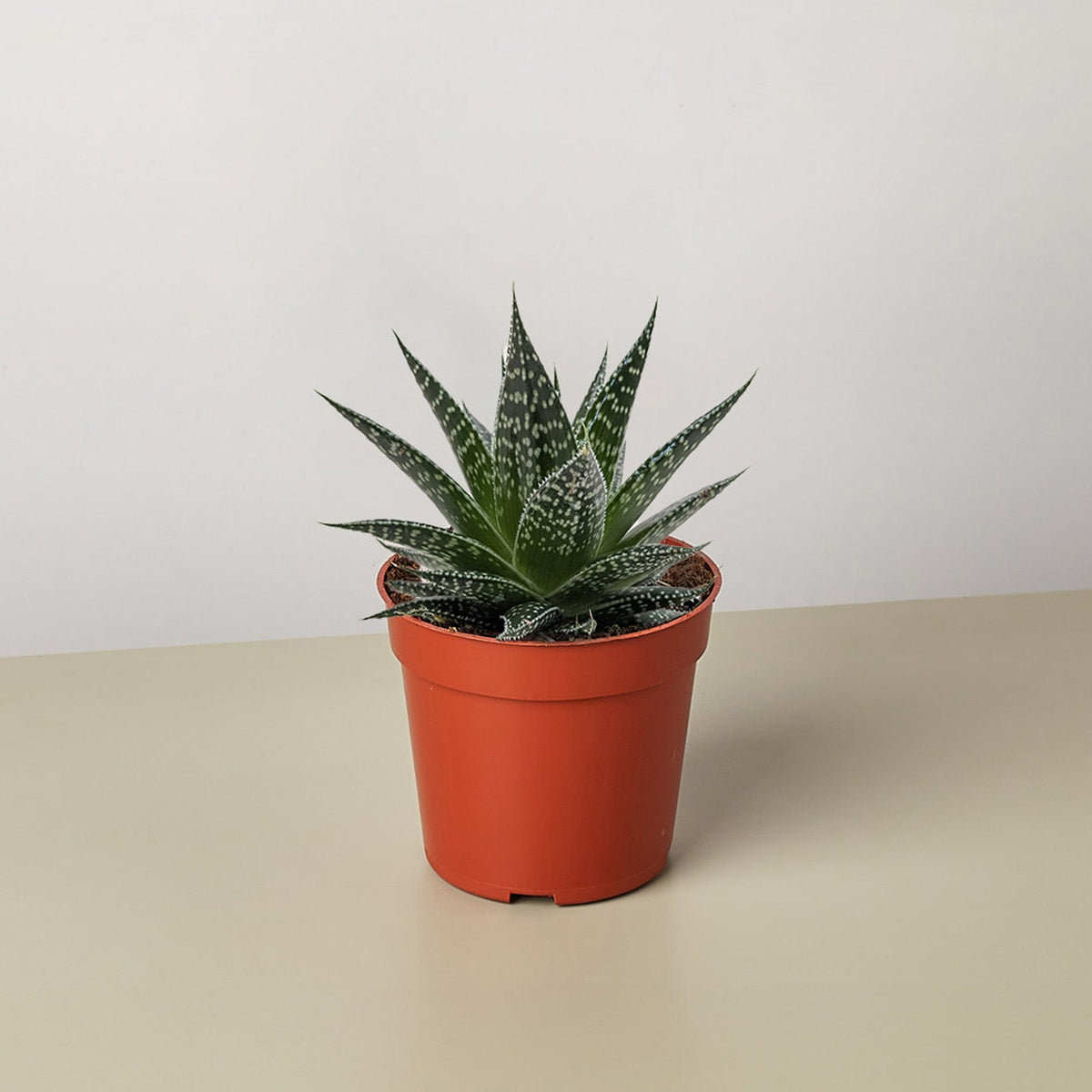
Bring rugged desert realism and unmatched physical durability into your naturalistic enclosure with Gasteria 'Durban'. Nicknamed "Ox Tongue" or "Cow Tongue" for its long, thick, and flattened leathery leaves, this South African succulent features subtle white speckling and striping across a deep jade canvas. While most succulents stretch, fade, and fail under typical vivarium lighting, Gasteria is uniquely adapted to low-to-moderate light understories—making it one of the absolute hardiest and most reliable live plants for arid and semi-arid reptile habitats.
Bioactive & Husbandry Benefits
- Trample-Resistant "Armored" Foliage: Unlike delicate succulents that drop leaves or snap when walked on, the rigid, paddle-like leaves of Gasteria easily support the physical weight and foot traffic of climbing geckos and active snakes without breaking.
- 100% Spineless & Animal-Safe: Completely free of dangerous puncture thorns, needles, barbed glochids, or caustic milky saps. It provides authentic desert aesthetics without presenting injury risks to reptile eyes, underbellies, or cloacas.
- Exceptional Low-Light Tolerance: While true desert cacti and rosette succulents quickly etiolate (stretch out weakly) without intense direct sunlight, Gasteria naturally grows in shaded rock crevices and thrives under standard vivarium LEDs and shaded enclosure corners.
- Thermal Micro-Shade & Sightline Security: The broad, stiff leaves cast low-level ground shade, creating essential cool micro-pockets where ground-dwelling reptiles can escape bright overhead lighting, thermoregulate, and feel secure.
- Arid Substrate & Microfauna Support: Establishes a fibrous root system that helps bind loose, gritty bioactive soils together, creating stable subterranean pockets where arid clean-up crews (Porcellio scaber, Armadillidium, and darkling beetles) can shelter and thrive.
- Non-Toxic Profile: Safe for insectivores and carnivores alike, with zero toxic resins. (Husbandry note: Best reserved for insectivorous and carnivorous setups, as the tough, fibrous leaves are not intended as a dietary staple for herbivorous lizards).
Habitat Specifications
- Light Requirements: Low to bright indirect vivarium LED lighting (one of the most shade-tolerant succulents in existence; keep leaf tips safely away from high-heat, unshaded basking bulbs).
- Humidity Range: 25% – 55% (tailored for arid, semi-arid, Mediterranean, and well-ventilated temperate habitats).
- Substrate & Moisture: Requires an open, free-draining arid substrate mix (such as topsoil, play sand, excavator clay, and pumice). Water deeply at the root zone only after the soil has completely dried out; avoid allowing water to pool continuously in the leaf joints.
- Enclosure Placement: Foreground or midground ground-planter; excellent positioned beside cork flats, slate basking steps, or cool-side hides.
- Ideal Inhabitants: Leopard geckos, African fat-tailed geckos, Western hognose snakes, Kenyan sand boas, rosy boas, viper geckos, cave geckos, and arid invertebrates (Blue Death Feigning Beetles, desert hairy scorpions).
- Structural Durability: Exceptionally High; one of the sturdiest, most crush-resistant live plants available for terrarium use.
Bioactive Prep Tip: Gently bare-root the plant to remove all commercial nursery potting mix, wash the foliage and root systems thoroughly in clean, dechlorinated water, and allow the roots to dry slightly before planting directly into your arid bioactive vivarium to ensure zero synthetic greenhouse fertilizers enter the habitat.